Personal Philosophy (Pt. 2)
Picture someone who hates exercising. You probably know someone like this, and you know how hard it would be to get them to go for a run - even a short one. Now imagine you teleport them to the middle of the Serengeti, and they are being chased by a lion. Now it’s really easy to get them to run.
This is an example (a bit of an extreme one, but still an example) of the HOW of my personal philosophy. I believe the best thing you can do to achieve your goals is to change your environment to orient yourself to where you want to go, so that in times of low motivation you are still compelled to work towards your goals. But why?
Imagine we were to create a model of how humans make decisions. I think a good model for this would be as follows. Each decision you make is determined by your:
- Internal world - your Self Image and State of Mind.
- External world - your Environment.
Now your environment and state of mind can change rapidly - much more so than your self-image. Hence why “who you are” is determined mostly by your self-image. When you think about it, self-development goals are really about changing your self-image, and that’s because it’s the hardest of the three things to change.
Anyway, these three factors (Environment, State of Mind, and Self Image) are the pure determinants of the Actions that you take. Actions lead to changing sensory information which feeds back into changing both your State of Mind and your Self Image. Therefore, State of Mind and Self Image feed back into themselves to form cycles.
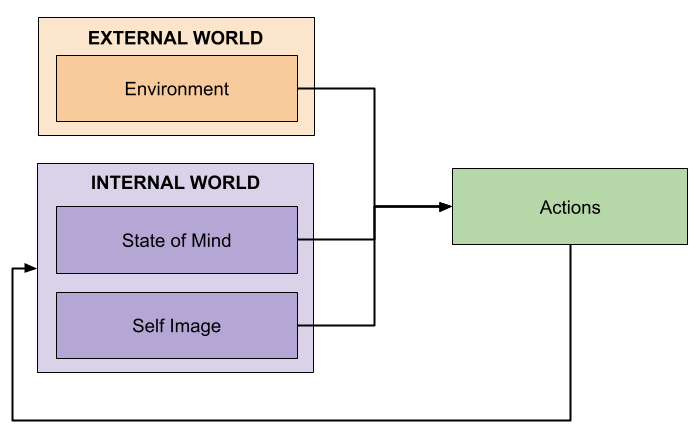
For example, our Self Image is often reinforced on a daily basis. You see yourself as the responsible one, hence you act responsibly; other people see you act responsibly and expect you to act responsibly, hence reinforcing your Self Image as the responsible one. You can replace the word “responsible” here with some other attribute, and the principle would be the same, whether you’re the fun one, the smart one, the nervous one, etc. But what if you are the “one” you don’t want to be? Due to this cycle, it seems impossible for your Self Image to just change on its own.
Hence, we fall into the trap of relying on State of Mind, i.e., motivation. Now sometimes, if the stars align, the goal isn’t too far away, and you REALLY, REALLY want something, motivation can get you there. But the more you want to change your Self Image, the less likely State of Mind will be able to get you there alone. I’m sure we all have had experiences of being motivated to achieve something one day, only for it to completely fade within a month, a week, or even a day.
Therefore, we move onto the final of the three Action determinants - Environment. This is the key to reliably achieving your goals and changing your Self Image. Taking advantage of times of high motivation, we must channel these into changing our Environment to set us up for long-term success.
I didn’t start waking up at 6:30am because I was motivated. I did it by:
- Setting a digital curfew so I couldn’t doomscroll through the night,
- Moving my bed next to my window so the natural light would wake me up early in the morning,
- Placing my phone (alarm) on the opposite side of the room so I would need to get out of bed in the morning to turn it off.
Now I don’t want to completely bash motivation. It is still useful. Motivation played a role here in that I was motivated to start waking up at 6:30am because I wanted to go to the gym while it was quiet. And being the guy that wakes up early to work out feels pretty cool, which motivates me to do it again. But if you notice, what I just said in the last sentence is a cycle. Hence, motivation can’t really be a driver of change, but only a maintainer, since it feeds back on itself. If I’m not waking up early to go to the gym, I don’t get the motivation to do it again. But regardless of whether or not I have the motivation to wake up early, I can still do it thanks to changes in my environment (listed above) pushing me to wake up early. And I haven’t always been perfect at waking up at 6:30am either; some days I sleep in because I was out late with friends, and some days I’m lazy. But the environmental factors steer me back on course in the end.
From here you just need to be patient, observe, and adjust accordingly. Just as much as environmental factors can redirect you back on course, environmental changes you didn’t see coming can also start to steer you off course as well. Oftentimes if you are working towards multiple goals at the same time, there will be environmental factors from one goal that work against another. Trying to be more social by staying out late with friends will make it harder to wake up early, for example.
This is why I think it’s also important to have a priority for your goals, so you know what to focus on when you have conflicts like this. This is why my Rules for the Summer are ordered from most to least important (and also why I haven’t been following rule #6 very well - I’ll try to post more from now on though ;) ).
I think the best way to summarize this philosophy is that motivation makes it easy to change, but it’s not reliable enough to be the driver of your change. Your environment, on the other hand, is.
And one final note… Since motivation still makes it easier to change, though, it is important to maintain it. How do we do this? Mainly by maintaining good mental and physical health to avoid burnout. Which really goes back to Part 1 of this philosophy.